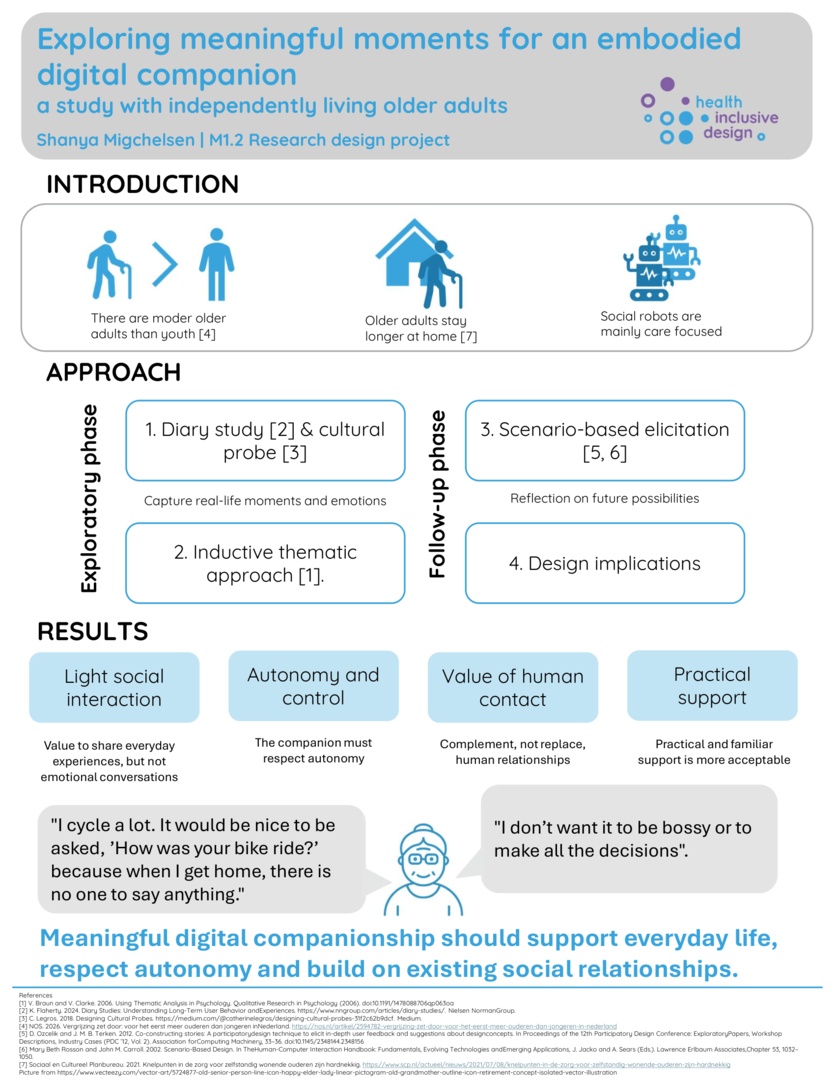
The number of older adults is increasing and in The Netherlands there are more older adults than young people. At the same time, older adults are living at home for longer and remain independent for a longer period of time. While social robots are developed for older adults who require care, less attention is given to the everyday moments of independently living older adults who may not yet need formal care, but may still experience emotional, social or practical need in daily life. Development in technology and artificial intelligence (AI) create possibilities for embodied digital companions that could support older adults in more subtle and meaningful ways. However, it remains unclear in which daily life moments such a companion could become meaningful.
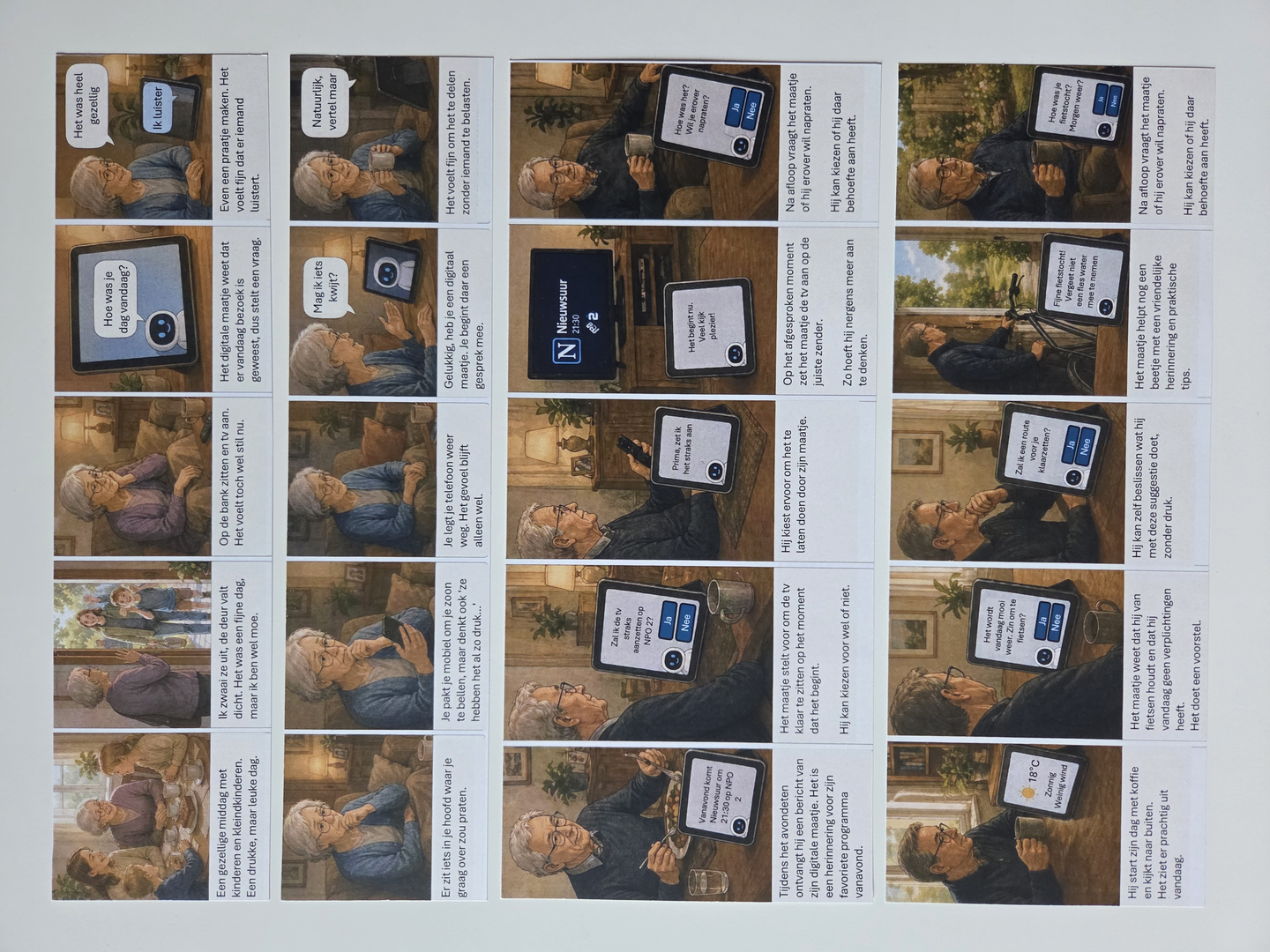
Therefore, this study explores the following research question: Which moments in the daily lives of independently living older adults create opportunities where an embodied digital companion can provide a meaningful role? To answer this question the research started with a diary study, to capture daily moments. Afterwards, a scenario-based interview is done to find out how a digital companion fits in those daily moments.
This study contributes a situated understanding of when an embodied digital companion may or may not be meaningful in the daily lives of independently living older adults. Rather than treating companionship as a general solution to loneliness, the findings show that opportunities emerge in specific everyday moments, such as transitions after activities, media use, meals or moments of reflection. At the same time, the study highlights important boundaries: the companion must respect autonomy, remain non-intrusive, and complement rather than replace human contact.